

Intuitive instruments — like the feeltone Monochord and Monolina — are designed so that anyone can pick them up and play immediately. There are no wrong notes. The strings are tuned to a single harmonic series, producing a rich, resonant drone that naturally supports meditation, sound healing, and deep listening.
But "easy to play" doesn't mean there's nothing to learn. The real depth of these instruments lies not in technique — it lies in presence.
When I first attended the "Secrets of the Monochord" training in Miami, I had already been playing my feeltone Monolina for three years. My credentials were extensive: a Master's degree in Music, years of voice and piano training, a technical diploma in audio engineering, multiple sound healing certifications, Reiki Master training, and my own group vocal facilitation method.
I assumed I only needed to tune the instrument, start strumming, and glorious tones would emerge. I was partly right — but I was missing something essential.
The course was created by Martina Gläser, wife of feeltone founder Ingo Böhme, who built his instruments around a single vision: music that anyone can make, with no wrong notes. Martina's training goes far deeper than playing mechanics.
The curriculum covers:
But the heart of the training is something harder to quantify: learning to listen at a deeper level, to feel subtle shifts in energy, and to allow sound to move through you rather than performing it.

I left the training feeling like the monochord and I had been through couples counseling. I had been playing it for years — but I hadn't truly been listening to it. I had been singing over it when it had so much more to say.
Tiny changes in how you play — pressure, speed, rhythm, breath — create completely different responses in the body. Mastering those subtle variations requires focused, expanded awareness. Presence, I learned, doesn't come from pushing your energy outward. It comes from emptying out and increasing your capacity to receive.

Martina Gläser and Joule L'Adara, 2015
One of the most striking things about this training is how it levels the playing field. Accomplished solo musicians walk away with new perspectives on simplicity and energy. Practicing Music Therapists discover how much there is to learn about subtle sound effects. Complete beginners — people who have never touched an instrument — find they have just as much to gain.
The monochord doesn't reward prior musical knowledge. It rewards presence.
When a group plays monochords together in unison, something remarkable happens. The stacking of harmonics creates an amplifying effect — the combined energy comes into cohesion and the result is exponentially greater than any individual player. Participants consistently emerge from this experience feeling expanded, clear, and creatively open.
The instruments bring body, mind, and spirit into alignment while opening the inner ear to deeper listening. It is a process of unfoldment — and it accelerates over two days.

Monochords are the ultimate mindfulness teachers. Setting their strings into motion initiates a process of beautiful unraveling — peeling away layers of "knowing" until what remains is pure openness to what is arising in the moment.
Even if we think we know, the practice of unknowing is the secret that unlocks all the dormant possibilities within us.
CE Credits are available for this course — inquire for more information.


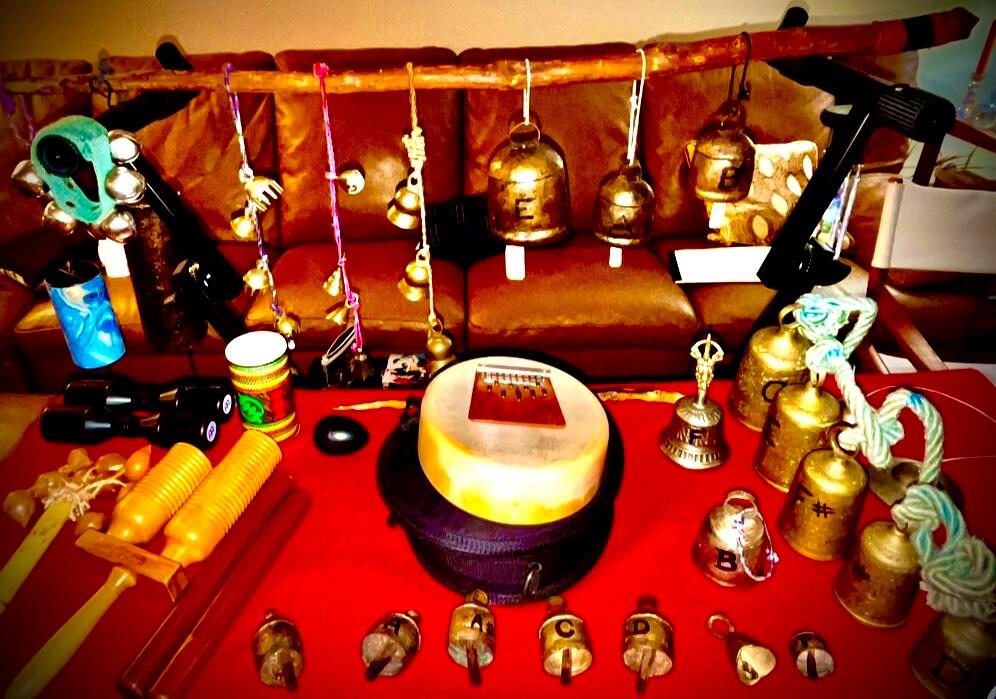
While our Soundscapes are centered around the Feeltone Monolina and Monolini and available in 4 tunings. But you don't need to own a monochord to take advantage of a matching collection.
Already have instruments? Find your root note and choose the collection that matches — then build from there.
Starting from scratch? Browse the collections, listen to the tunings, and find the one that speaks to you.